01 · OEM
2.7 MW
Siemens Gamesa
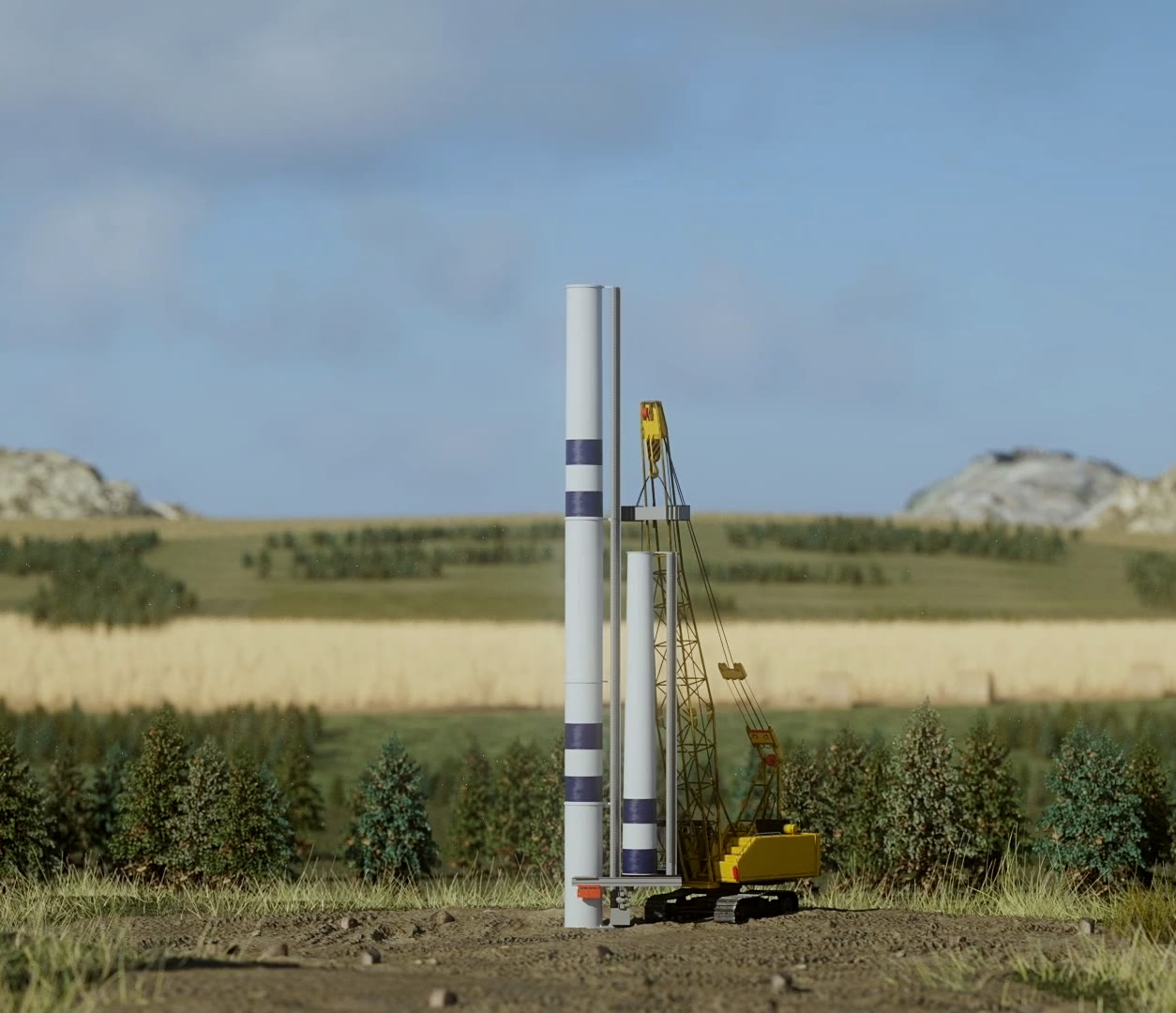
An elevating platform that installs and services turbine components at any hub height, faster and at lower cost than cranes, with the reach to go taller when a project needs it.
48% lower crane and civil works cost than crane-based installs, with the same platform across new build, MCR, re-powering, and decommissioning. Site-specific designs delivered for Siemens Gamesa, Vestas, and GE Vernova platforms.
Crane and civil works cost, conventional crane install vs KINKA LIFT™.
Modeled from
real project values. USD primary; EUR in parentheses.
Conventional install
Mobile cranes and civil works, full project
$36M (€33M)
KINKA LIFT
Same project: platform, support crane, civil works
$18.6M (€17M)
Saved
$17.4M 48%
§ 01
Conventional cranes scale exponentially with height. Lifting 100 tons to 10 meters uses a 100- or 200-ton crane. Lifting the same load to 100 meters needs a crane 5 to 10 times larger. KINKA LIFT scales linearly: the same system reaches 100, 200, or 300 meters by adding chord sections, with no step up to a larger capacity class.
A small crane lifts to roughly 10 meters to load components onto the elevating platform. Above that, KINKA LIFT carries the lift.
Control stays sensor-informed and operator-directed throughout. Real-time sensors track connection, load, and motion, and automatic safety locks are designed into the lift mechanism. The operator stays in command.
§ 02
Vertical lift loads travel from the platform through KINKA LIFT's structural chords into the existing concrete and steel foundation. The tower only sees a small stabilizing load at the flange, its strongest point, used to maintain verticality and prevent buckling on the slender chord members.
This is why existing towers, new towers, and retrofit candidates across most OEM platforms are compatible, with no cutting or welding on the tower.
01 · OEM
2.7 MW
Siemens Gamesa
02 · OEM
4.2 MW
Vestas
03 · OEM
6.1 MW
GE Vernova
For major component replacement and retrofit lifts, KINKA LIFT uses temporary structural couplers. The couplers are non-intrusive: no cutting, no welding, no modification of the existing component. The same coupler technology is already deployed in offshore marine heavy-pulling operations, so the underlying engineering is field-proven before it ever touches a wind turbine. For new build and full intermediate flange installations, conventional bolted connections are used. Chord sections are transported in roughly 10-meter lengths and bolted into a full chord on site.
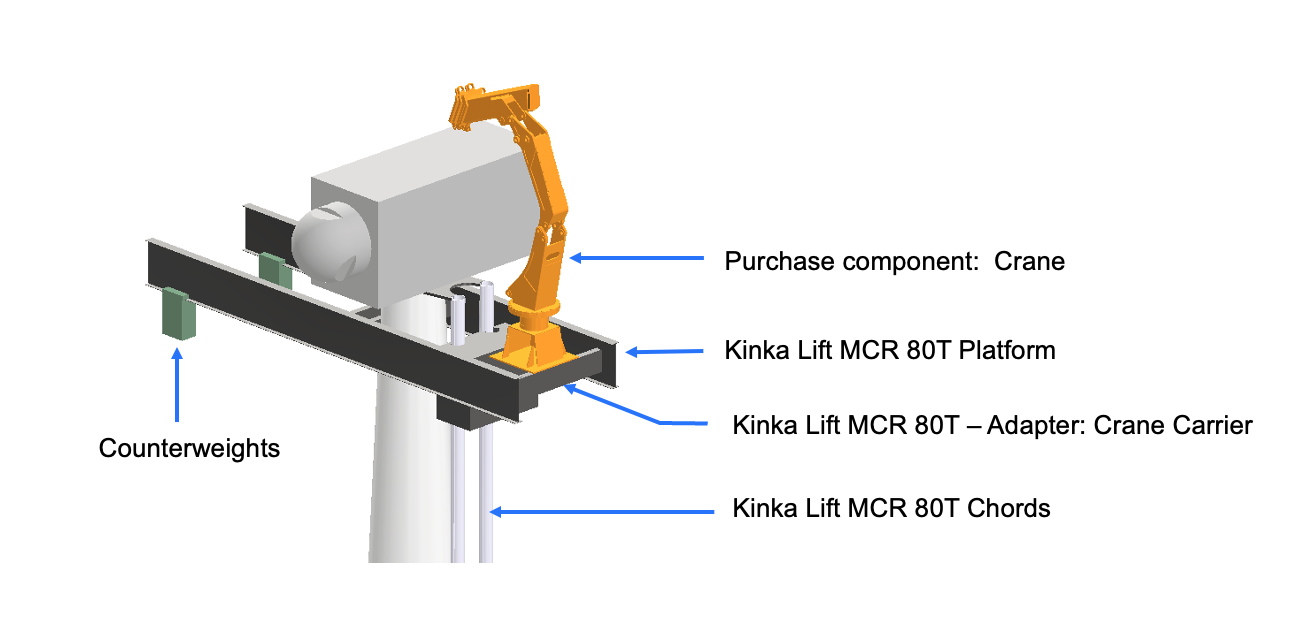
Once a component is fastened to the elevating platform, it is carried on a guided path, not suspended from a hook, so it does not swing. The only crane lift is the short transfer to the platform at the base of the tower, and because that lift is short, pendulum and dynamic amplification are reduced.
Wind stops a tall crane lift long before it stops the rest of the site. With KINKA LIFT the only suspended lift is the short one at the base of the tower, so more of the calendar is workable.